
Distracted Driving Dangers and Device Use: Stay Focused, Stay Safe

One quick glance at a phone can cover the length of a cricket pitch many times over. At 80 km/h, a driver who looks away for five seconds travels about 111 metres without properly watching the road. That is long enough to miss a braking bus, a two-wheeler changing lanes, a pedestrian crossing, or a pothole that forces a sudden swerve.
Device use while driving has become one of the most common forms of distraction on Indian roads. Phones, navigation screens, music apps, smartwatches, and in-car infotainment systems all compete for attention. The danger is simple: driving already asks the brain to track speed, space, mirrors, signs, people, road surface, and the behaviour of other drivers. Add a screen, and attention gets split at the exact moment it needs to stay sharp.
This is why Distracted Driving Dangers and Device Use deserves more than a reminder in a road safety campaign. It is a daily decision that affects everyone sharing the road.

Why device use behind the wheel is so dangerous
Driving is not just physical. It is visual, mental, and manual.
A device can distract in all three ways:
Type of distraction | What happens while driving |
Visual | Eyes leave the road to read a message, check a map, or select a song. |
Manual | One or both hands leave the steering wheel to hold, swipe, type, or adjust a device. |
Cognitive | The mind shifts from driving to a conversation, notification, video, or task. |
Texting is especially risky because it often combines all three. A driver looks down, uses a hand, and thinks about the message. Even a short reply such as “reaching in 10” can create a dangerous gap in awareness.
The same applies to common habits that feel harmless:
Reading a notification at a red light and continuing to look after traffic moves
Opening a map while already driving
Searching for a playlist on a highway
Checking a delivery app, work chat, or family group message
Holding a phone under the steering wheel to hide it from traffic police
Watching short videos while stuck in slow traffic
Looking at a smartwatch notification and losing sight of the road ahead
The risk does not disappear just because the car is moving slowly. In crawling traffic, two-wheelers pass closely, pedestrians step between vehicles, and drivers make sudden lane decisions. A distracted driver has less time to react.
The numbers show a serious road safety problem
Road crashes rarely have one single cause. Speed, road design, weather, vehicle condition, driver behaviour, and enforcement all play a role. Still, device-related distraction appears clearly in road safety data.
According to India’s Ministry of Road Transport and Highways road accident reporting, mobile phone use was linked to thousands of road crashes in recent annual reports. The 2022 report recorded 3,395 road accidents associated with mobile phone use and 1,132 deaths. These numbers are already alarming, and they may not capture the full scale of the problem.
Device-related crashes are often underreported because distraction is hard to prove after a crash unless there is a witness, phone record, camera footage, or driver admission.
Global research also points in the same direction. The World Health Organization has warned that drivers using mobile phones are about four times more likely to be involved in a crash than drivers who are not using one. The risk is not limited to handheld calling. Hands-free conversations can still take attention away from scanning the road and predicting hazards.
Numbers make the issue visible, but the real impact is human. Every device-related crash can mean a family waiting for someone who does not arrive, a rider left injured on the roadside, or a driver living with guilt after a preventable mistake.
What distraction looks like on Indian roads
Indian roads demand constant awareness. A driver may need to read the behaviour of a cyclist, watch for cattle, slow near a school zone, handle an auto-rickshaw stopping suddenly, and respond to a bus moving across lanes, all within a few seconds.
That makes device use even more dangerous.
A phone screen narrows attention. A driver may still “see” the road in a general sense, but miss small cues that matter:
Brake lights turning on several vehicles ahead
A two-wheeler drifting into the lane
A pedestrian looking ready to cross
A child stepping from behind a parked car
A vehicle door opening on a narrow street
A traffic signal changing from amber to red
A speed breaker without clear markings
Many crashes happen not because the driver failed to see a large object, but because they missed the early warning signs. Safe driving depends on noticing those signs early enough to slow down, create space, or change position.

Hands-free does not mean risk-free
Hands-free tools can reduce manual distraction. A secure phone mount, voice assistant, Bluetooth calling, and built-in navigation can all help when set up before driving. They are safer than holding a phone.
Still, hands-free is not a free pass.
A difficult call can absorb attention. A voice assistant that misunderstands a command can frustrate the driver. A map rerouting at a complex junction can distract at the worst time. Even when both hands stay on the wheel, the mind may be elsewhere.
The safest approach is to treat hands-free as a backup, not a habit. Use it for essential tasks only, and keep the interaction short.
A simple rule helps: if the task can wait, let it wait.
That includes:
Replying to messages
Checking social media
Browsing music
Reading news alerts
Looking at photos or videos
Searching for food, fuel, or parking while moving
Typing destinations after the trip has started
Pull over safely if a task needs attention. Use a proper parking spot or a safe shoulder where stopping is allowed. Hazard lights do not make every stopping place safe.
Practical ways to stay focused before the trip starts
Most distraction can be prevented before the vehicle moves. A two-minute setup can remove ten temptations later.
Set navigation before moving
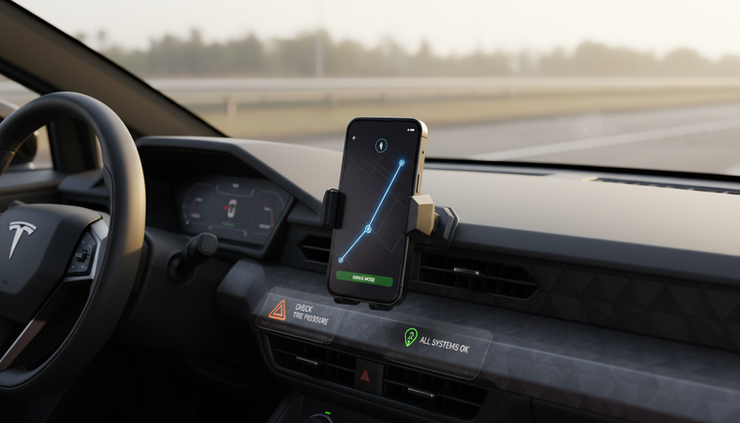
Enter the destination while parked. Check the route, traffic estimate, tolls, and major turns before starting. If using a phone, place it in a sturdy mount at eye level or near the dashboard, not in the lap or cup holder.
Choose voice guidance if it helps, but keep the volume moderate. The goal is to hear instructions without needing to stare at the screen.
Put the phone on Do Not Disturb
Most smartphones have a driving mode or Do Not Disturb setting. Turn it on before leaving. Some phones can send automatic replies such as “I’m driving and will respond later.”
That single setting reduces one of the biggest triggers for distraction: curiosity. A silent phone is easier to ignore than one that keeps buzzing.
Choose music or podcasts in advance
Scrolling through songs while driving is still device use. Pick a playlist, radio station, audiobook, or podcast before the trip. If someone else is in the vehicle, ask them to manage audio and calls.
Keep volume low enough to hear horns, sirens, and surrounding traffic.
Secure loose devices
A phone sliding off the seat can create panic. Drivers often reach down by instinct, which is extremely dangerous. Keep phones, chargers, earbuds, and power banks in a fixed place.
If a device falls while driving, leave it. Stop safely before picking it up.
Tell people not to expect instant replies
A lot of phone use while driving comes from social pressure. Work messages, family calls, delivery updates, and group chats can feel urgent.
Set a clear expectation with close contacts: calls and messages may be answered after arrival. If a call is truly urgent, the caller can try again, and the driver can stop safely before responding.
What to do when the phone feels impossible to ignore
The strongest safety tips are often practical, not perfect. Many people know device use is risky and still feel pulled towards the screen. That pull is designed into modern apps. Notifications are meant to grab attention.
Try these habits:
Keep the phone out of reach
Put it in the glove box, bag, or back seat. Distance breaks the automatic reach.
Use one-tap driving mode
Add driving mode or Do Not Disturb to quick settings so turning it on takes seconds.
Make stopping the default
If a call or message matters, stop first. Do not negotiate with yourself while moving.
Use passengers wisely
Ask a passenger to reply, change music, or check directions. Be clear that the driver’s job is only to drive.
Avoid emotional calls
Arguments, stressful work calls, and upsetting news can steal attention long after the call ends. Save them for later.
Build a start-up routine
Seatbelt, mirrors, destination, driving mode, then move. Repeating the same routine makes safe behaviour easier.
Do not trust short glances
Most people underestimate how long they look away. A “quick check” often lasts longer than expected.
Focus is not about willpower alone. It is about designing the drive so the safer choice becomes the easier choice.
Passengers can help prevent distraction too
Road safety is not only the driver’s responsibility when others are in the vehicle. Passengers can make a real difference.
A passenger can:
Handle navigation changes
Read messages aloud only when necessary
Reply on behalf of the driver
Remind the driver to ignore the phone
Lower music during complex traffic
Avoid showing memes, videos, or photos to the driver
Speak up calmly if the driver starts using a device
A simple line can work: “Let’s stop for a minute if you need to check that.”
This avoids blame and gives the driver a safer option. Speaking up may feel awkward, especially with elders, friends, or colleagues, but silence can be costly.
Parents and guardians also set the tone for younger passengers. Children notice whether adults treat phone use behind the wheel as normal. A child who grows up seeing drivers ignore devices is more likely to carry that habit forward.
Safer technology helps, but habits matter more
Modern vehicles and phones offer useful safety features. Lane warnings, emergency braking, voice commands, Bluetooth audio, and driving focus modes can reduce risk. Some apps can detect driving and silence alerts automatically.
These tools help, but they cannot replace attention.
A warning beep may come too late. A driver assistance feature may not detect every obstacle. A voice assistant may still require mental effort. Safe driving still depends on a person watching, thinking, and reacting.
Technology should support attention, not compete with it.
The best setup is quiet and simple:
Phone mounted or out of reach
Notifications silenced
Route ready
Audio selected
Calls avoided unless essential
Eyes up and scanning

A focused driver protects more than one vehicle
The decision to ignore a device while driving protects more than the person behind the wheel. It protects riders on two-wheelers, schoolchildren, pedestrians, passengers, roadside workers, cyclists, and other drivers who may never know a crash was avoided.
That is the quiet power of focused driving. Nothing dramatic happens. No one has to brake suddenly. No one falls. No one gets a call from a hospital. Everyone simply reaches where they were going.
The next time a notification appears while driving, let it wait. Set up hands-free options before starting, use Do Not Disturb, pull over when something truly needs attention, and make focused driving a non-negotiable habit.
If this issue has affected you, as a driver, passenger, pedestrian, or family member, share your experience and thoughts. Honest conversations can change behaviour. A story that feels personal may be the reminder someone needs before their next drive.



Comments